Saturday, June 6, 2009

YOU REST YOU RUST

This is Vi. She's probably around eighty--"a spry eighty," guesses my dad. Vi lives in Texas in the winter and up here in Minnesota in the summer. She has a bountiful organic garden and sells vegetables and other relics and products out of her garage, hours: whenever.

Everything you see here is for sale, from glass bricks to flowering cactus. Swollen plastic jugs of honey: $7.50. Jars of beets she grew and pickled herself: $4.50. Old well-seasoned cast iron skillets: $5-10. Assorted glassware: 10 cents to a buck. Poplar logs: ask. Huge bottles of pure vanilla extract brought back from Mexico: $11. Radishes: she charged us 50 cents for a generous handful.

This is her garage refrigerator.


When I was growing up here, Dolores Nepsund (wildly creative cake baker, multi-grandma) had a perpetual garage sale out of her garage in town. In warm enough weather, she just left the garage door open, and you'd go in and sort through the heaps of donated clothes on the tables and racks and if she wandered in, you'd pay her, and if she didn't, you left the money in an honor system contraption. I wore a green wool duffel coat from that garage for seven years, from Ohio to Norway to New York, until it was threadbare at the hems and all the toggle-loops had broken.

Across the road from the lake, there is still an honor-system vintage shop set up in a little refurbished camping trailer parked in Iva Thielges' front yard. Inside, you find old picnic sets and paint-by-number horse portraits and dolls and embroidered dish towels etc., and a little hinged box where you write down what you bought and leave the money.

I prefer this kind of economy, run by old women and based on trust.

Thursday, June 4, 2009

TEENAGE DEVIATIONS IN AN IDEAL WORLD

I am very happy to be in northern Minnesota right now, watching minnows startled by my foosteps shoot out from under the dock, biking in the cool evening air by the birch trees whose delicate round leaves jingle like green coins in the breeze, past a dairy farm with shockingly clean black-and-white cows snacking on towering fluffy haystacks, toward a burrito at CompaƱeros that is hiding midwest-style under a thick blanket of melted cheese and sauce, looking up to see a waxing moon emerging bright in the still-blue sky, chopping up tart fresh rhubarb stalks for a homemade pie with my dad, and eating the pie with ice cream, and etc.

But if there were any other place I could be tonight it would be Portland, for the preview opening of my friends Mary and Asza's collaborative art show at Fontanelle Gallery. It is called, succinctly enough, "Lesbian Art Show," and it opens for real tomorrow and if you live in Portland you should go see it. If not you should click on "Lesbian Art Show" and flip through the pictures. Some of it is tongue-in-cheek, some of it is really vulnerable and sharp, some is Dada, some of it has a Chris Johanson-esque vibe I like (maybe it's the hand-lettering and the townscapes), some is all these things at once. I can't wait to see it in real life. (Next week!) 

Here are a few of my favorites, at least as translated via the world wide web.

"Teenage Deviations in an Ideal World"


"A Map Mostly About Opinions"


"Styles of Lesbos" (just because Aubree and Torrence look so cute)


"Lesbian Art Show" itself

On a side note, I struggle with the strange fate of the word "lesbian"--it's been so misappropriated by straight porn and shock jocks. Decontextualized, it risks sounding lecherous and fake. (To clarify, I am not talking about "Lesbian Art Show" and other such specific projects and contexts, but the more generalized use of the word.) In case we can't ever fully reclaim it, at least in The Larger Culture, I wonder what will take its place? I would love to find a word that a) encompasses a broader sense of genders and b) doesn't conjure images of long-nailed girls gone wild frenching each other lasciviously with one eye on the camera.

Tuesday, June 2, 2009

BIRCH WATER AND OTHER DELIGHTS

I left Oberlin at 3:45 pm Sunday and arrived in northern Minnesota at 5:15 pm Monday. Turbo trip! My speedometer works approximately twice a month, and on neither day of this drive. The needle just hangs out at 20mph, going or stopping. So I had no idea how fast I was going, I would get myself into a comfortable car sandwich and go with the flow, figuring that if we were speeding outrageously the highway patrol would target the leader or the end of the line. Worked!

Emmett was an agreeable companion but no help driving.

On day one I blazed through Indiana and Illinois without pause. On day two I did the final 400 miles in a single shot, not even stopping for gas or restroom or Twizzlers. I just wanted it to be over. The right side of my body was numb by the time I arrived. Fortunately my dear and loquacious friend Melissa called around the time I was passing through Staples and we talked through the last hour-plus, 'til the phone grew hot and I had switched arms several times. This, I fear, is the point at which one's brain is being microwaved, but it made the time fly by.

Things I saw and heard on my drive, in order of appearance:
• a trio of glossy chocolate-colored mules, grazing
• a sign for FANGBONER ROAD
• an abandoned farmhouse collapsing backwards, overgrown with ivy
• speed metal on the radio while driving through rural Wisconsin at night, including a song called "Corey Feldman Holocaust"
• heat lightning over the field in Madison where my friends and I were running around with Emmett at midnight
• at least a dozen dead deer (which bear a disturbing coloring resemblance to Emmett), one of which had a neon-orange X spraypainted across its bloated and stiff torso in the dark
• two small crosses perched on a hillside next to 94, each decked with flower garlands and topped with a blaze-orange hunting cap
• a billboard for a place called Crystal Cave whose website is acoolcave.com
• an Adopt-A-Highway section sponsored by Minnesota Atheists
• girls walking through Menahga in shorts and flip-flops, it felt like true summer

Home at last, I went to Amy and Aaron's for dinner out in the woods. Amy had made homemade butter with local cream, which she sprinkled with pink Hawaiian sea salt. Delicious!

The leftover buttermilk she turned into a delicious cool cucumber gazpacho, which also featured pureed almonds and some kind of oil (walnut? olive?) and, best of all, juicy halved green grapes swimming near the bottom like little sweet treasures. This, along with tender mellow radishes from the garden and ciabatta and cheese and wine, is just the pre-dinner snack. Then we had a Spanish vegetarian feast, replete with shitaake mushrooms and sweet scallions grilled over the fire and homemade mayo and garden greens and chickpea stew and things whose names I cannot remember! And ice cream with cloudberries for dessert.

Then after dinner Amy pulled out the birch water. When the sap was running in May, she and Aaron tapped some birch trees and collected gallons of the gushing water. They boiled down some of it to make birch syrup (it takes 70 gallons of birch water to make a gallon of syrup, compared with 40 of maple), but they kept a lot of the birch water just to drink .

The taste is so delicate and subtle I can hardly even describe it; all I can say is that birch water is the purest, cleanest, most delicious water I have ever drunk in my life. It tastes clear and alive. Amy declared that she wanted to drink it until she replaced every ounce of water in her body with it. Sign me up!

P.S. You should see the crazy car cake she and Aaron made for their son's second birthday. And also, the cooking classes she is going to offer out in their deep-woods paradise.

Tuesday, May 19, 2009

"AND THE TYPOGRAPHY IS ALL DONE IN THE SAME TYPEFACE AS MONEY"

This makes me want to read God Says No, James Hannaham's debut novel:
"There are a lot of novels out there that make you think America is England, you know?" responds Hannaham, describing the type of fiction he deliberately didn't write. "That book is sort of—it's dark green, and there's a very sort of sensuous but depressing-looking cover: a photograph, there's like a blurry thing in the distance. It's a beach maybe, and the title describes a relationship between a mother and a daughter, or a mother and a father, or a father and a daughter. And the typography is all done in the same typeface as money, and the interior is all about small lives lived in a small way. I've often felt like those books don't have much to do with the way life is actually lived in America." (— interview in the Village Voice)
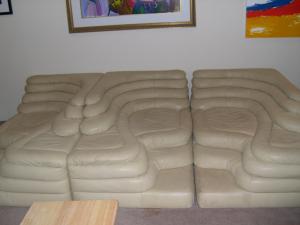
Funny and true! If I remember correctly from meeting him in Austin at AWP a few years ago, he's also the man behind Revolting Sofas, a blog of terrible sofa pictures harvested from Craigslist with accompanying mini-stories by various authors. I tend to skim the stories and gawk at the sofas, some of which are merely trashed and some of which give me a weird crawling feeling just looking at them.

It's hard for me to even have that one sofa there. I feel like its creepy pale ripply surface is contaminating the whole post. I have to tip the balance by putting in more photos. Such as:

an overweight hedgehog (thank you Gail), my childhood dog Shady (1985-1998) swimming in the lake,

a rock that looks like a monster at the Oregon coast, and my beloved friends Brock and Nick after breakfast in Portland.

That feels better.

Here too is the cover of James Hannaham's book, which officially hits the shelves next Tuesday.

Monday, May 18, 2009

DERBY REDUX

A friend with an inside connection contests some of my criticisms of below, and since yesterday's post I've mellowed on the subject. Update: many participants were bike co-opers who put together the bikes themselves, and the kids cleaned it all up. I'm still not into the final outcome of a burning pile of wrecked bikes. But I can understand and appreciate the desire to keep the anarchic spirit of the Bike Derby alive.

Here's my final thought on it. I think that traditions and rituals worth holding onto are also worth adapting and reinterpreting. Whether it's marriage, Christmas, pedagogy, the Bike Derby, or whatever, I believe it's important to figure out what long-standing elements are worth keeping and what elements need to evolve to fit the times and one's own personal/political/ethical beliefs. I would love to see future organizers take the raucous, performative, and physical elements they love and make the Derby their own, in a way that speaks to the present and the future, not just the past.

Not that this matters to anyone outside Oberlin, I suppose.

Onward!

Here is Bernard in his well-worn ANC T-shirt from 1991.

That's radical.

Sunday, May 17, 2009

BACK FROM THE GRAVE... AND REVISED

When people ask if it's weird to be back at the same place I went to college, I usually answer that what's weird about it is how not weird it feels. My old coffeehouse is now a bar, but same owners, and I order the same things I used to make when I cooked there; nearly all of my mentors and professors are still here, now my colleagues; my fellow alums are everywhere, teaching and administrating and running restaurants and just living. Not much changes in a town of 8,000 people. From the day I arrived, I felt at home, and if Guided by Voices comes up in the shuffle I sometimes have to remind myself what decade it is.

Today, though, I felt the schism between my two lives here. What happened was that some students here revived an O.C. tradition that originally ended in 1993, the Bike Derby, but has been picked up off and on again over the last couple of years. The Bike Derby was an annual demolition derby on bikes, with costumes, in front of Harkness Co-op, but that doesn't begin to describe the gleefully destructive punk mayhem that it was. You can get a pretty good sense of it from this two-part video of the 1992 Derby:


The enterprising students involved in today's Derby apparently sought to recreate the whole thing from YouTube, down to every live-music and throwing-buckets-of-compost detail. But it's like when you try to clone a pet. It just isn't the same animal. Or maybe it's just that I am not the same animal.

Originally I posted a longer detailed report/critique, a viscercal reaction written in the heat of the post-Derby moment. A day later my feelings have cooled off, and I've got more information from people involved directly and indirectly, and accordingly I've come around on several of the things that bothered me as an observer. [See REDUX, above.]

Don't get me wrong, the costumes and the spirit of the thing were great.

The part where they torch the bikes still bothers me and is the part I believe is worth rethinking.

It was particularly ironic to see a pile of newly-destroyed bicycles set aflame, black smoke billowing from the burning tires, before the backdrop of the state-of-the-art new environmental studies building. In that moment, I couldn't help thinking the whole stunt could just as well have been a demonstration by Republican wingnuts.


Amazingly enough, the whole thing was apparently cleaned up within the hour. So props for that. Over and out.

Saturday, May 16, 2009

EUROVISION!!!

The blog's been quiet for a while, I know. I have been working very hard. Now I am relaxing very hard: soft-serve blackberry ice cream, lazy afternoons playing Catan on the porch, whiskey-ginger ale-maple syrup cocktails in mason jars, forays to community rummage sales and state parks, dance parties, even an hour-long massage I "won" (i.e. bought impulsively) at a benefit. (Totally worth it.) My small-town life has gone from teeming hive to sunny vacation lifestyle.

Today I spent the afternoon watching the Eurovision song contest with two Russian professors and an authentic Pole. Have you seen this show before? It is so ridiculous and campy. (America should have a 50-states version.) Musical representatives from the twenty-five finalist countries perform outrageously tacky songs; then the audiences in each of the 42 participating countries get to vote by phone, on the condition that they cannot vote for their own country.

Highlights:
• Since Russia won last year, this year's contest took place in Moscow. Earlier today, Moscow gays assembled a pride parade, at which the police promptly arrested 35 people. The towering Swedish (p)opera diva Malena--she of the four-octave range and arms that make Madonna and Michelle O look like saplings--declared in solidarity, "Today, I am gay!"

• Ukraine got shafted in the vote but was one of my over-the-top favorites. Granted, at first I guffawed at the bizarre hamster-wheels-from-the-future set, lit up in green and black like a commercial for an energy drink, the singer wriggling in her sequined-stiletto-knee-high-boots, and the men's tiny sex-gladiator outfits that really made them look like silver-painted Marvin the Martians. The song: "Be My Valentine! (Anti-Crisis Girl)." The lyrics make as much sense as the title.

But then a drumset appeared on the stage and Svetlana abruptly hopped off the gladiator she was mounting, took the throne, and pounded out several bars, and I loved her. It happens at 2:47 in this video.


• Albania, what on earth was this guy about? When he wasn't Krishna-ing behind the singer, he was doing elementary somersaults off to the side. Turquoise? Sequined? Full-face hood? And it's not even a unitard?


• The German guy wore skintight silver glittery leggings. Not even the gracious Dita Von Teese tickling her riding crop up his chest could salvage his heterosexuality. (If he ever claimed it.)

• The Danish "rock band" gamely made the most of their performance, which by venue seems inherently doomed destroy their rock credibility forever. The tight-trousered guitarists strutted like C.C. DeVille and swung their lank locks as if they were playing an actual rock show and not international karaoke camp. The drummer wore sunglasses. Someone had on a cowboy hat.

• The weird thing is that once it comes to the final voting, all the long-simmering rivalries instantly melt and an inexplicable, almost provincial neighborliness kicks in. Finland votes for Sweden; Bosnia-Herzegovina grants its highest score to Serbia; Ukraine's top vote goes to Russia; Cyprus loves Greece.

(Exception: Armenia gave not a single point to Turkey.)

• Norway won! It was a little ridiculous, this "Fairytale" song, and I wasn't into the Disneyish pink princess dresses--you can't wear that kind of thing if you're blonde, you just look tacky--but I liked that the little guy sang and played the violin and wrote the music and the lyrics. And he won by a landslide--387 points, with second-place Iceland at 218 points and Azerbaijan with 207. (Who knew Azerbaijan was Europe?)

Trivia: In Norway, they call the contest Melodi Grand Prix. I have no idea why.
More trivia: Alexander Rybak (the little guy) is originally from Belarus. He moved to Norway when he was four.

• Finally, what is a Eurovision recap without a nod to ABBA, who, as true scholars will know, got their big break in the contest with "Waterloo" in 1974. Agnethe's boots/pants combo is fab. Poor Frida, is all I'll say about her look.

Monday, April 27, 2009

FOREST PARK HAUNTS ME TOO

It is important to always remember that at any time you think of it there are people being kept in buildings when they want to go outside.

—from My Abandonment by Peter Rock.
I highly recommend it.


Friday, April 24, 2009

RICK PRELINGER'S 14-POINT MANIFESTO

The esteemed archivist and champion of artistic re-use Rick Prelinger came and gave a talk here a couple months back. If you don't already know about the Prelinger Archives, check it out. Prelinger and his people collect and save and offer for free public use more than 60,000 (and growing) archival films, from advertisements to instructional films to public service announcements. The reels of vintage television commercials are totally absorbing.

Next time I go to San Francisco I am excited to visit this place in person.

Here's my notes from the PowerPoint presentation Rick gave.

REVISITING THE VALUES OF EXISTING MATERIAL, A 14-Point Manifesto

1. Why add to the population of orphaned works?
"We're in the world capital of ephemera," says Prelinger. And: "We cling to the absurd idea that products of our mind become property the instant they're born."
2. We assume the new is better than the old.
3. Honor our ancestors by recycling their wisdom.
"I don't like eternalizing the present," he says, because we don't know now what will be meaningful later.

4. The ideology of originality is arrogant and wasteful.
And here he inserts a graphic of the hydrologic cycle.
5. Dregs are the sweetest drink

6. And leftovers were spared for a reason.
The library he runs is "a library filled with bad ideas... I like to joke that it's 98 percent false consciousness." And this is important, he says: "You can't judge the past only at its best--you need to confront the contradictions" and what didn't work. He compares it to the finding that farm kids suffer fewer allergies, possibly due their exposure to manure and dirt, and that rooting around in the archive can have a similar effect, building up your immunity to bad ideas.

7. Actors don't get a fair shake the first time around, let's give them another.
What he calls "reincarnation through reuse." He says: "We should use copyright homeopathically, not as a tool of shock and awe." (That's right, U2. Leave Negativland alone.)

8. The pleasure of recognition warms us on cold nights and cools us in hot summers.
"Rivers are like information--they route around obstacles, and rivers are most exciting at their bends."

9. We reach the future by typically roundabout means.
"Storytelling as we know it is not an absolute." Rather, we're conditioned to favor a particular kind of storytelling, character-based with a certain narrative arc that in documentaries in particular depends on a predictable formula of character with a problem --> character surmounts problem in second half. "We value it for wrapping new skins on old skeletons." And the dominance of this template is "tyrannical."

10. We hope the future is listening, and the past hopes we are too.

11. What's gone is irretrievable, but it might also predict the future.
This was the part that really stuck with me. Here he talked about those old films from the 1950s that are about behavior and manufacturing etc. and how there was a wave of fascination and interest in them in the '80s (and into the '90s too, judging from my own college experience.)

The problem, he says, is that people tended to see these old filmstrips as purely funny or kitschy, or be caught up with the style, the color, the voice, the funny rigidity of the mannerisms. But, he urges, "Don't see them as antiquated but as predictive"--and points out with frightening accuracy that all those movies of perfect controlled schoolchildren in the 1950s did not actually reflect the free-roaming ways of kids then, but in fact looks a lot more like today's suburban children, who are far more restricted and controlled in their movements than children anytime in the 20th century.

12. Access to what's already happened may be easier to get than access to to what's happening now.

13. Use justifies archives.

14. Make a quilt, not an advertisement.
"Quilting is an early form of sampling."

Here's a sample from the archives: "Are You Popular?" (1948), "a scream and a sobering document of postwar conformity" (and it features an actress named Bunny Catcher!)

• "Perversion for Profit" (1965), produced by Citizens for Decent Literature

TWO CENTS

As social networking becomes more an intrinsic part of real life, I have a couple suggestions to make it even more like real life. 

1) Twitter should introduce the option: "Pretend To Follow This User." 
Maintains the socially comfortable illusion of mutuality while liberating you from [tedious Twitter peeve of your choice].

2) Here are some other responses Facebook could add to its comment options.